.avif)
How to Choose the Perfect Engagement Ring for Your Proposal (A Complete Guide)

Choosing an engagement ring is one of the most important decisions you'll make before your proposal. It can also be one of the most stressful. You want it to be perfect, but you're navigating an industry full of technical jargon, conflicting advice, and a dizzying number of options.
After working with hundreds of couples planning proposals in Bali, we've heard every ring-related question, panic, and last-minute crisis imaginable. This guide covers everything you actually need to know, from figuring out the right size without ruining the surprise to getting the ring safely to Bali.
How to Find Your Partner's Ring Size (Without Them Knowing)
This is the question we get asked the most, and the one that causes the most anxiety. Here are the methods that actually work:
Borrow a ring they already own. Wait for a moment when your partner isn't wearing one of their rings. Ideally, pick one they wear on their ring finger, not their thumb or index finger, since sizes vary significantly between fingers. Take it to a jeweler for sizing, or trace the inside circle on paper as a backup. Return it before they notice.
Ask their friends or family. There's a good chance someone close to your partner already knows their ring size, or would be willing to help you find out. A common approach: have a friend suggest trying on rings together while shopping, then casually note the size.
Use a ring they've left at home. If your partner leaves rings on the nightstand or in a jewelry box, you can slide one onto your own finger and mark where it stops, then measure that with a jeweler. It's not perfectly precise, but it gets you close.
The string method (use with caution). Some people try wrapping a string around their partner's finger while they sleep. This can work, but it's risky. Light sleepers will wake up, and the measurement is often inaccurate. If you try this, use a thin strip of paper rather than string for a more reliable result.
When in doubt, go slightly larger. A ring can always be resized down more easily than up. Most jewelers offer one free resizing within the first year. If you're between two sizes, choose the larger one.
Understanding the 4 Cs
Every diamond is graded on four characteristics. Understanding these helps you make a smart decision rather than just choosing the most expensive option.
Cut is the most important factor. It determines how much a diamond sparkles. A well-cut diamond reflects light beautifully even if it's smaller or has slight imperfections. Cut is graded from Excellent to Poor. Always prioritize cut over the other three Cs.
Carat refers to the diamond's weight, not its size (though the two are related). A higher carat means a larger stone, but two diamonds of the same carat weight can look different sizes depending on how they're cut. A well-cut 0.9 carat diamond can look larger than a poorly cut 1.0 carat.
Clarity measures how many natural imperfections (called inclusions) are inside the diamond. The scale runs from Flawless to Included. Here's the insider tip: you don't need a Flawless diamond. Most inclusions in the VS1-VS2 range are invisible to the naked eye, and those grades cost significantly less than Flawless or VVS.
Color is graded from D (completely colorless) to Z (noticeable yellow tint). For most engagement rings, diamonds in the G-H range look colorless to the eye and offer much better value than D-E grades. The color difference between a D and a G is virtually undetectable without specialized equipment.
Lab-Grown vs. Natural Diamonds
This is one of the biggest decisions you'll face in 2026, and there's no wrong answer. It depends entirely on what matters most to you as a couple.
Lab-grown diamonds are chemically, physically, and optically identical to natural diamonds. The difference is origin: one forms over billions of years underground, the other is created in a lab in weeks. In 2026, lab-grown diamonds cost roughly 80-90% less than natural diamonds of the same size and quality. That means you could get a stunning 1.5 carat lab-grown diamond for the price of a 0.5 carat natural one.
The trade-off: lab-grown diamonds have lower resale value, and prices continue to drop as production technology improves. If long-term investment value matters to you, natural diamonds hold their worth better.
Natural diamonds carry tradition, rarity, and stronger resale value. For many couples, the symbolism of a stone that formed over billions of years matters deeply. The downside is cost, along with ethical considerations around mining, though the industry has made significant improvements in sourcing transparency.
Our honest take: Most couples we work with in Bali are choosing lab-grown diamonds in 2026. The cost savings are dramatic, the quality is identical, and many couples prefer to invest the difference in the proposal experience itself or the honeymoon. But this is a deeply personal choice, and there's no wrong answer.
Popular Ring Styles and What They Say
Your partner's personal style offers the best clues for choosing the right ring. Here are the most popular options:
Solitaire: A single diamond on a simple band. Timeless, elegant, and the most popular choice for a reason. Works for partners who prefer classic, understated style.
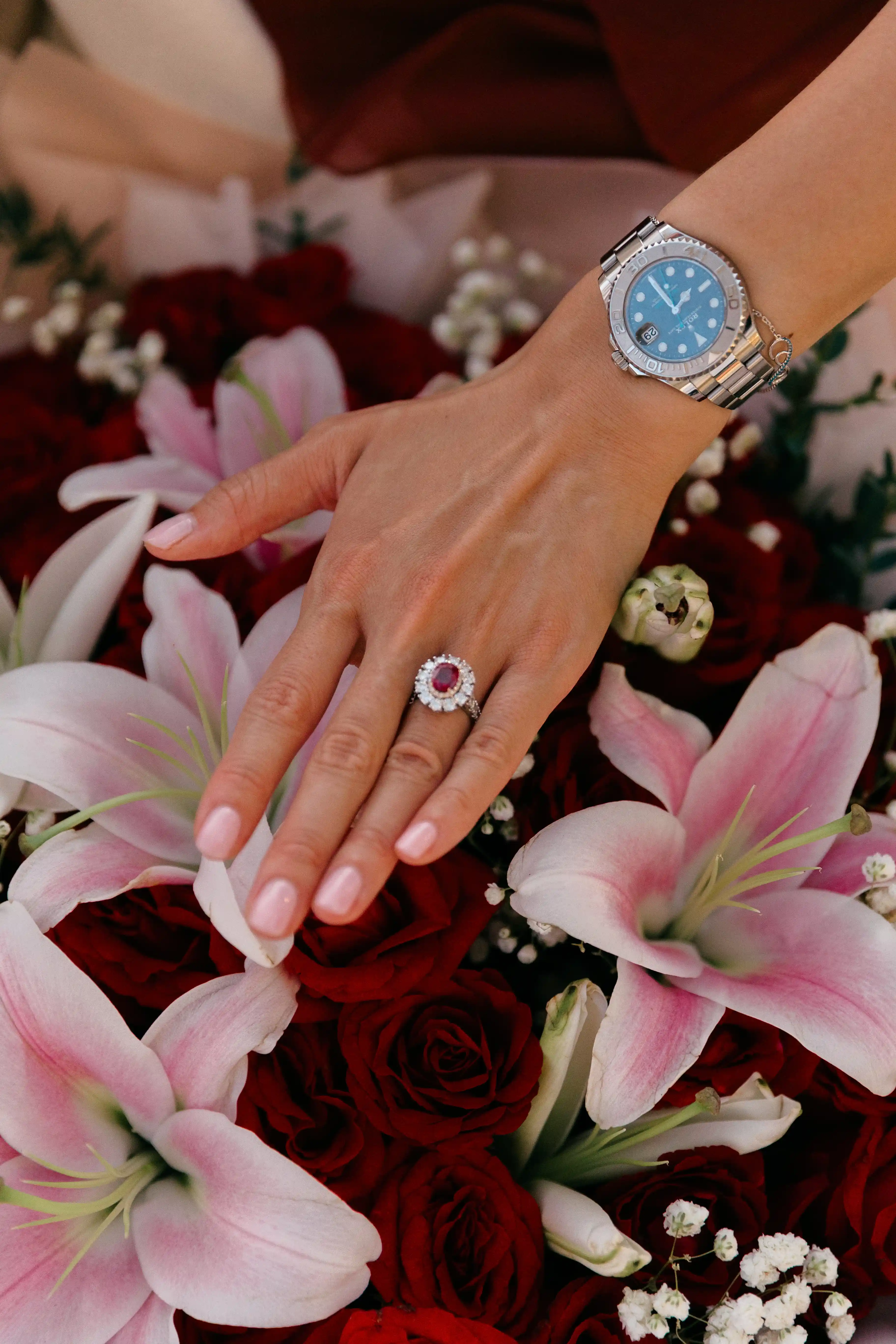
Halo: A center diamond surrounded by a ring of smaller diamonds. Creates the illusion of a larger stone and adds extra sparkle. Great for partners who love statement pieces.
Three-stone: A center diamond flanked by two smaller stones. Often chosen to represent past, present, and future. Appeals to partners who appreciate symbolism.
Vintage or Art Deco: Intricate detailing, milgrain edges, and unique cuts. Perfect for partners drawn to antique jewelry or distinctive, one-of-a-kind pieces.
Bezel setting: The diamond is encircled by a thin rim of metal rather than held by prongs. Increasingly popular in 2026 for its modern look and practicality. The stone is more secure and less likely to snag on clothing.
A hidden clue: nail shape. This is an insider tip that surprisingly few people know about. Your partner's preferred nail shape can point you toward complementary ring styles. Almond-shaped nails pair beautifully with oval or marquise cuts. Square nails suit princess or asscher cuts. Round nails harmonize with classic brilliant-cut diamonds. It's not a rule, but it's a remarkably reliable shortcut.
Setting a Budget (Without the Outdated Rules)
Forget the old 'three months' salary' rule. That was invented by a diamond marketing campaign, not by financial advisors. The right budget is whatever feels comfortable for your financial situation.
In 2026, couples spend anywhere from a few hundred dollars (lab-grown or alternative stones) to tens of thousands (large natural diamonds in custom settings). There's no minimum amount that makes a proposal meaningful.
A few practical tips: decide on your total proposal budget first (ring + travel + setup), then allocate accordingly. If you're proposing in Bali, you might choose to spend less on the ring and more on creating an unforgettable proposal experience, or the other way around. Both approaches are completely valid.
Many jewelers offer payment plans, and buying online from reputable retailers (with certification and return policies) can save 20-40% compared to traditional brick-and-mortar stores.
Getting the Ring Safely to Bali
This is the part most people don't think about until the last minute, and it causes more stress than it should.
Always carry it in your hand luggage. Never put the ring in checked baggage. Checked bags get lost, delayed, or mishandled. Your carry-on stays with you at all times.
Airport security won't be a problem. Engagement rings don't set off metal detectors and won't raise concerns at security screening. The ring box might show up on the X-ray scanner, but security staff see jewelry constantly. They won't draw attention to it or announce what it is.
Keep it in the ring box with padding. Wrap the box in a sock, scarf, or sweater inside your bag. This protects it from damage and also makes it less obvious if your partner happens to glance into your bag.
You generally don't need to declare it at customs. Since the ring is a personal item that will leave the country with you (on your partner's finger), customs declarations typically aren't required. However, if your ring is very high value, consider photographing yourself with the ring and keeping the receipt. This proves it wasn't purchased abroad if customs asks questions on your return trip.
Consider travel insurance. Most standard travel insurance policies don't cover jewelry above a certain value. If your ring is expensive, check whether your home insurance or a specialized jewelry insurance policy covers international travel. A dedicated jewelry policy typically costs 1-2% of the ring's value per year.
Don't carry it in your pocket all day. We've seen ring boxes fall out of shorts pockets, nearly get left at restaurants, and one almost ended up in the ocean. On the day of the proposal, give the ring to your planner, photographer, or someone you trust. Let them bring it to the setup location. You focus on enjoying the day with your partner and staying relaxed.
Frequently Asked Questions
What if I choose the wrong ring?
Most reputable jewelers offer exchange or return policies within 30-60 days. Some couples also choose to propose with a temporary 'placeholder' ring and then shop for the real one together afterward. This takes the pressure off completely and ensures your partner gets exactly what they want.
Should I buy the ring online or in a store?
Both are valid options. Online retailers often offer better prices and wider selection. In-store purchases let you see and compare stones in person. If buying online, make sure the retailer provides GIA or IGI certification, a clear return policy, and high-resolution images or videos of the actual stone.
How far in advance should I buy the ring?
At least 4-6 weeks before your trip, longer if you're ordering a custom design. This gives you time for delivery, potential resizing, and peace of mind. Rush orders are possible but add stress and cost.
Does the ring need to match my partner's other jewelry?
Not necessarily, but it helps to notice whether your partner typically wears gold or silver-toned jewelry. If they wear mostly gold, a yellow gold band will feel cohesive. If they wear silver or white gold, platinum or white gold is a safer choice. Rose gold works as a middle ground and has become increasingly popular.
Ready to Plan Your Proposal?
The ring is one piece of the puzzle. The proposal itself, the location, the timing, the element of surprise, and the emotion of the moment, is what your partner will remember forever.
At Forever Promises Bali, we help couples design proposal experiences that match the significance of the ring you've chosen. From private cliffside setups to intimate villa reveals, we handle every detail so you can focus on the moment.
Contact us to start planning your proposal. We'll help you create a moment as perfect as the ring.
See our proposal setups | Browse our services | Read our proposal ideas